Introduction: Cricket Stadiums in India
Cricket has always been more than just a sport in India; it is a passion that unites millions of people across the country and evokes emotions that are hard to describe. From bustling streets of Mumbai to the serene banks of the Hooghly River in Kolkata, cricket is omnipresent, and the stadiums where the sport is played have become symbols of India’s love for the game. Indian cricket stadiums are not only architectural marvels but also historic grounds where legendary matches have been played, records have been broken, and unforgettable memories have been created. Each stadium in India has a story to tell, whether it is the grandeur of the Narendra Modi Stadium in Ahmedabad, the historic charm of Eden Gardens in Kolkata, or the electric atmosphere of Wankhede Stadium in Mumbai. These stadiums are designed not only to host international matches, Test matches, One Day Internationals, and T20 games but also to provide world-class facilities to players and spectators alike. The evolution of cricket stadiums in India reflects the growth of the sport itself, starting from small colonial-era grounds to modern multi-functional arenas that can host more than a hundred thousand spectators, equipped with advanced technology, floodlights, and luxury boxes. Over the years, cricket stadiums in India have also become iconic landmarks, attracting tourists, fans, and cricket enthusiasts from around the world who come to witness the magic of Indian cricket firsthand.
Table of Contents
History of Cricket Stadiums in India
The history of cricket stadiums in India dates back to the British colonial era when the sport was first introduced in the country. Initially, cricket was played in open fields, parks, and small grounds in cities such as Mumbai, Kolkata, and Chennai. These grounds gradually evolved into structured stadiums as the popularity of cricket grew among Indians. The Eden Gardens in Kolkata, established in 1864, is considered one of the oldest cricket stadiums in the world and has witnessed countless historic matches and legendary players over the years. With time, stadiums began to incorporate larger seating capacities, better infrastructure, and modern facilities to accommodate the growing number of cricket fans. The expansion and modernization of Indian stadiums were further accelerated after India gained independence, and with India emerging as a major cricketing nation, the need for world-class facilities became more prominent. Today, India boasts some of the largest and most technologically advanced cricket stadiums globally, blending history, architecture, and modern amenities to create unforgettable experiences for both players and spectators.
Major Cricket Stadiums in India
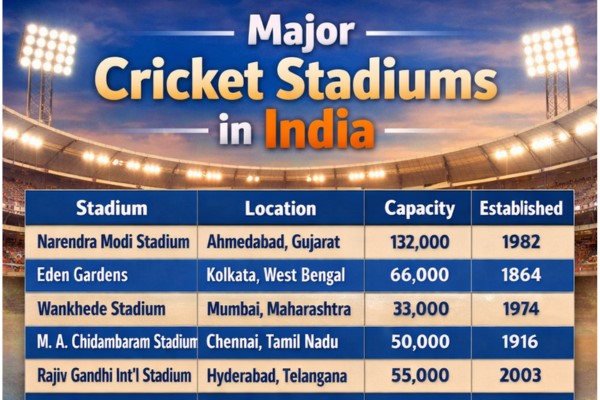
India is home to some of the most famous and iconic cricket stadiums in the world, each with its own unique character, capacity, and significance. These stadiums not only host international matches and domestic tournaments but also serve as cultural landmarks that symbolize India’s deep-rooted passion for cricket.
Narendra Modi Stadium, Ahmedabad
The Narendra Modi Stadium, located in Ahmedabad, Gujarat, is currently the largest cricket stadium in the world, with a seating capacity of 132,000 spectators. Originally known as the Sardar Patel Stadium, it was established in 1982 and underwent extensive renovation in 2020 to modernize the facilities and enhance spectator experience. The stadium is equipped with state-of-the-art indoor practice pitches, modern seating arrangements, luxury boxes, and advanced drainage and lighting systems. It regularly hosts international matches, Indian Premier League (IPL) games, and major cricket tournaments, attracting cricket fans from all over the world. The scale of this stadium, combined with its architectural brilliance and modern amenities, has set a new benchmark for cricket stadiums globally, making it a symbol of India’s ambition and commitment to cricket.
Eden Gardens, Kolkata
Eden Gardens in Kolkata, often referred to as the “Mecca of Indian Cricket,” is one of the oldest and most historic cricket stadiums in India, established in 1864. With a seating capacity of 66,000 spectators, Eden Gardens has witnessed numerous legendary matches, unforgettable moments, and historic cricketing events, including the 1987 and 1996 Cricket World Cups. The stadium is renowned for its electric atmosphere, passionate fans, and iconic colonial-era architecture. Every time India plays a match here, the stadium comes alive with the cheers of thousands of cricket enthusiasts, creating an unforgettable experience for players and spectators alike. Its history, charm, and role in shaping Indian cricket make Eden Gardens a cultural and sporting landmark that transcends generations.
Wankhede Stadium, Mumbai
Wankhede Stadium, located in Mumbai, Maharashtra, is another iconic cricketing venue that has played a central role in Indian cricket history. Established in 1974 with a seating capacity of 33,000 spectators, Wankhede is known for its lively atmosphere, stunning coastal views, and world-class facilities. The stadium is famous for hosting the historic 2011 Cricket World Cup final, where India won the trophy in front of thousands of ecstatic fans. Wankhede regularly hosts international matches, IPL games, and other domestic tournaments, attracting fans with its energy, vibrant crowd, and electrifying atmosphere. It is a stadium where legends are made, and cricketing memories are etched forever in the hearts of fans.
M. A. Chidambaram Stadium, Chennai
Also known as Chepauk Stadium, M. A. Chidambaram Stadium in Chennai, Tamil Nadu, is one of India’s oldest cricket stadiums, established in 1916, with a seating capacity of 50,000 spectators. Known for its spin-friendly pitch and traditional architecture, this historic stadium has hosted countless domestic and international cricket matches over the decades. The passionate local fans add to the stadium’s electric atmosphere, making it a challenging venue for visiting teams. Its history, charm, and association with some of India’s most legendary cricketers make it an iconic cricketing ground that continues to inspire players and fans alike.
Rajiv Gandhi International Cricket Stadium, Hyderabad
Rajiv Gandhi International Cricket Stadium, located in Hyderabad, Telangana, is a modern cricket stadium established in 2003, with a seating capacity of 55,000 spectators. The stadium has rapidly gained prominence for hosting high-profile IPL matches, international cricket series, and other major tournaments. Known for its modern infrastructure, spacious seating, and excellent visibility, it is a favorite among both players and spectators. With advanced facilities, including practice areas and floodlights, Rajiv Gandhi Stadium represents India’s commitment to providing world-class cricketing experiences in emerging cities and regions.
M. Chinnaswamy Stadium, Bangalore
M. Chinnaswamy Stadium in Bangalore, Karnataka, established in 1969, is a renowned cricket stadium with a seating capacity of 40,000 spectators. It is known for its batting-friendly pitch, vibrant atmosphere, and scenic surroundings. The stadium regularly hosts IPL matches for the Royal Challengers Bangalore franchise, as well as international cricket games. Equipped with modern floodlights, practice facilities, and spectator amenities, Chinnaswamy Stadium has earned a reputation as one of India’s most exciting venues for cricket, consistently producing high-scoring matches and thrilling finishes.
Holkar Cricket Stadium, Indore
Holkar Cricket Stadium in Indore, Madhya Pradesh, established in 1990 with a seating capacity of 30,000 spectators, is a relatively newer venue in India’s cricketing landscape. Despite its modernity, it has quickly become a popular ground for international matches, IPL games, and domestic cricket tournaments. Known for its well-maintained pitch, modern amenities, and vibrant atmosphere, Holkar Stadium has established itself as a preferred venue for both players and fans, reflecting India’s ongoing efforts to expand world-class cricketing infrastructure beyond traditional metropolitan cities.
Unique Features of Indian Cricket Stadiums
Indian cricket stadiums are celebrated not only for hosting matches but also for their unique features, combining history, architecture, technology, and fan experience. Modern stadiums like Narendra Modi Stadium and Rajiv Gandhi Stadium showcase architectural brilliance with advanced seating arrangements, luxury boxes, indoor practice pitches, and spacious auditoriums. Historic grounds like Eden Gardens and Chepauk retain their colonial charm while integrating modern facilities. Stadiums are equipped with advanced floodlights for day-night matches, modern drainage systems to prevent rain delays, state-of-the-art practice areas, VIP lounges, and large LED screens for spectator engagement. Beyond physical infrastructure, the atmosphere of Indian stadiums is electrifying, with passionate fans, choreographed chants, and a collective energy that makes home games intimidating for visiting teams. This unique combination of modern technology, history, and fan culture makes Indian cricket stadiums some of the most iconic venues in the world.
Cricket Events Hosted in Indian Stadiums
Indian cricket stadiums have hosted a wide range of historic events, from World Cups to domestic tournaments, shaping the legacy of Indian cricket. Eden Gardens, Wankhede, and Chinnaswamy Stadium have been venues for historic Test matches and ODIs, producing unforgettable cricketing moments. Indian Premier League (IPL) matches have transformed stadiums into centers of entertainment, with fan zones, music, light shows, and spectacular presentations attracting thousands of spectators. Stadiums in India have hosted every major cricketing event, from ICC tournaments to bilateral series, cementing their status as integral pillars of cricket culture and history.
Cricket World Cups
India has hosted multiple Cricket World Cups, including the 1987, 1996, and 2011 editions. Historic matches at Eden Gardens and Wankhede have become part of cricket folklore, with the 2011 World Cup final at Wankhede being one of the most celebrated moments in Indian cricket history.
Indian Premier League (IPL)
The IPL has revolutionized cricket stadiums in India, transforming them into arenas of entertainment where cricket meets spectacle. Stadiums host league matches with music, fan zones, and grand light shows, creating a festive environment that attracts fans from all over the world.
Historic Test Matches
Historic Test matches, particularly India vs Pakistan encounters at Eden Gardens, and spin-dominant matches at Chepauk, have created legendary moments. These venues are known for their challenging pitches, passionate crowds, and unforgettable cricketing experiences.
Conclusion
Cricket stadiums in India are not just venues for matches; they are landmarks, cultural icons, and historical monuments that reflect India’s deep passion for cricket. From the grandeur of the Narendra Modi Stadium to the historic charm of Eden Gardens, each stadium has a story to tell, hosting iconic matches and legendary players. With modern infrastructure, advanced facilities, and electrifying atmospheres, Indian stadiums continue to attract fans from across the globe. As India remains a dominant force in world cricket, its stadiums will continue to be the heart of unforgettable moments, cultural celebrations, and sporting excellence, symbolizing the spirit of cricket that unites a nation.
Related Posts

Epic South Africa National Cricket Team vs New Zealand National Cricket Team Timeline: Complete 30+ Years History, Legendary Matches, Iconic Players & Defining Moments
Introduction: Epic South Africa National Cricket Team vs New Zealand National Cricket Team Timeline The South Africa National Cricket Team vs New Zealand National Cricket Team timeline is one of the most…

England Cricket Team vs New Zealand National Cricket Team Timeline: A Complete History of an Evolving Cricket Rivalry
Introduction: England Cricket Team vs New Zealand National Cricket Team Timeline The England cricket team vs New Zealand national cricket team timeline represents one of the most fascinating journeys in international cricket.…
West Indies Cricket Team vs India National Cricket Team Match Scorecard: Complete and Epic Rivalry History
The rivalry between the West Indies cricket team and the India national cricket team is one of the most historically rich and statistically fascinating rivalries in international cricket. Stretching back to the…